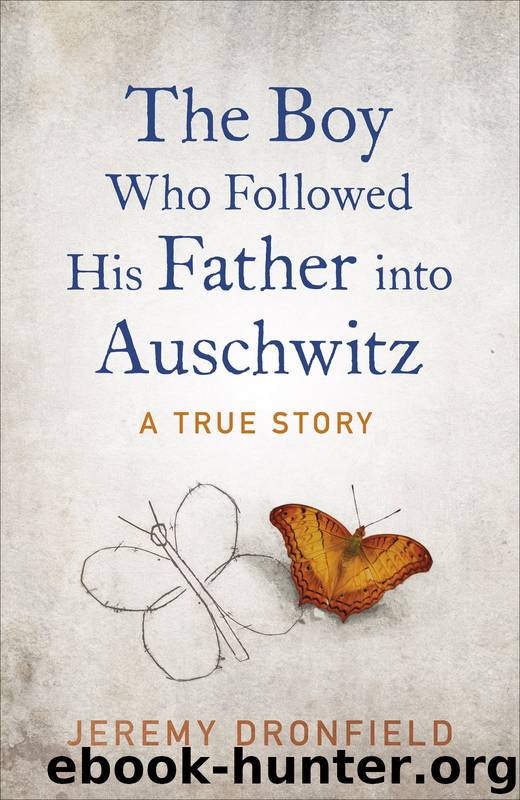
The Boy Who Followed His Father into Auschwitz by Jeremy Dronfield
Author:Jeremy Dronfield
Language: eng
Format: epub
ISBN: 9780241359181
Publisher: Penguin Books Ltd
Published: 2018-11-15T16:00:00+00:00
אחים
Auschwitz-Monowitz, now completely built, was a small, simple camp. It had no gatehouse: just a plain gateway in the double electrified fence. A single street ran the length of the enclosure, a distance of just 490 metres.7 Barrack blocks lined the road: three rows to the left, two to the right. About halfway along was the roll-call square, with a smiths’ workshop and kitchen block to one side. There was a grass border, carefully tended, as were the verges and flower beds in all concentration camps; the contrast between the care given to these patches of decoration compared with the abuse and murder of human beings was a paradox which drove some prisoners mad.8
A little farther along, on the left-hand side of the street, stood block 7. Outwardly it was no different from the others: a wooden barrack, not particularly well made. But inside it was very special, for this block belonged to the Monowitz Prominenten. These were not like the Prominenten Fritz had known in Buchenwald; there were no celebrities or statesmen here; just the kapos, foremen and men with special duties – the functionary prisoners, the inmate aristocracy.9 Gustav Kleinmann, camp saddler and new-minted Aryan, was one of them. Having come here as the lowest of the low, he was now among the most privileged.
In his personal contentment, Gustav was slowly becoming less conscious of the sufferings of others, or at least less disturbed by them. He worked indoors, and the abuse happened mostly out of his sight. On the rare occasions he took out his diary, it was to record how peace had settled on the camp, and that fewer prisoners were being sent to the gas chambers – albeit because the selections at Birkenau were becoming more thorough in weeding out and murdering the weak. By Gustav’s reckoning, about 10 to 15 per cent survived from each transport – ‘The rest are gassed. The most gruesome scenes play out.’ But still, ‘Everything is more peaceful in Monowitz, a proper work camp.’ To Gustav’s experienced eye, its primary purpose was to exploit, not to destroy its inmates, and the horror of life within its fences was diminished compared with what he had seen. It was as if he had finally lost the ability to perceive it all in comparison with the normal, civilized world.
Even so, two things weighed on him severely. One was separation from Fritz. The other was the man who hovered above all the Prominenten like a malevolent, bloodsucking bat: Josef ‘Jupp’ Windeck, the camp senior and chief of all the kapos and functionary prisoners. The SS could not have picked an enforcer more suited to their ideal than Jupp Windeck.
He wasn’t much to look at – small and slight, with the bearing of a weakling. But his appearance was belied by the temperament of a tyrant.10 His bland, characterless features expressed disdain and scorn; he loved to lord it over his fellow men, and trample them down to enhance himself. A German, Windeck had
Download
This site does not store any files on its server. We only index and link to content provided by other sites. Please contact the content providers to delete copyright contents if any and email us, we'll remove relevant links or contents immediately.
Fanny Burney by Claire Harman(26660)
Empire of the Sikhs by Patwant Singh(23135)
Out of India by Michael Foss(16985)
Leonardo da Vinci by Walter Isaacson(13411)
Small Great Things by Jodi Picoult(7221)
The Six Wives Of Henry VIII (WOMEN IN HISTORY) by Fraser Antonia(5557)
The Wind in My Hair by Masih Alinejad(5137)
A Higher Loyalty: Truth, Lies, and Leadership by James Comey(5017)
The Crown by Robert Lacey(4861)
The Lonely City by Olivia Laing(4841)
Millionaire: The Philanderer, Gambler, and Duelist Who Invented Modern Finance by Janet Gleeson(4538)
The Iron Duke by The Iron Duke(4404)
Papillon (English) by Henri Charrière(4322)
Sticky Fingers by Joe Hagan(4253)
Joan of Arc by Mary Gordon(4156)
Alive: The Story of the Andes Survivors by Piers Paul Read(4076)
Stalin by Stephen Kotkin(4003)
Aleister Crowley: The Biography by Tobias Churton(3671)
Ants Among Elephants by Sujatha Gidla(3494)
